
My mother was not merely a woman who decorated for holidays. She was a one-person Bureau of Seasonal Embellishment, operating out of our little house with the grim efficiency of a defense contractor and the artistic conviction of Michelangelo with a paint brush. Nothing in that house was safe. Doorknobs, clocks, lampshades, innocent pieces of furniture minding their own business—all of them sooner or later found themselves improved, adorned, festooned, or otherwise drafted into the great pageant of Mom’s imagination. The cuckoo clock, a dignified old Germanic relic that had survived years of daylight savings time and family shouting, suddenly acquired a red pompom on the nose of the deer. That deer, I am convinced, never recovered its self-respect. In our small hamlet, my mother earned the title Martha Stewart of the neighborhood.
Of course, no great empire of decoration is built without labor, and my sister and I were the labor. We were conscripted into production like two small factory hands in a seasonal sweatshop, surrounded by pipe cleaners, paint pots, dried glue, and those old Reader’s Digests that somehow became the raw material for every major holiday known to Western civilization. Fold the pages just so, add a Styrofoam head, slap on some yarn for hair, and behold: a Christmas choir lady, a Halloween witch, or any number of faintly alarming paper citizens. My sister possessed skill, which in a family operation, is always a dangerous thing. She painted owls, witches, and ceramic objects with such alarming competence that my mother beamed like a foreman meeting quota. I, on the other hand, worked with the desperate speed of a prisoner tunneling under a wall. My goal was not beauty. My goal was escape—from crafts, from supervision, and from the suffocating smell of tempera paint. My witch emerged as a small, grim little citizen of Halloween—black clothes, pale face, and green polka-dot freckles scattered over her like a curse from the craft table, looking suspiciously like the freckled constellation I wore on my own skin.
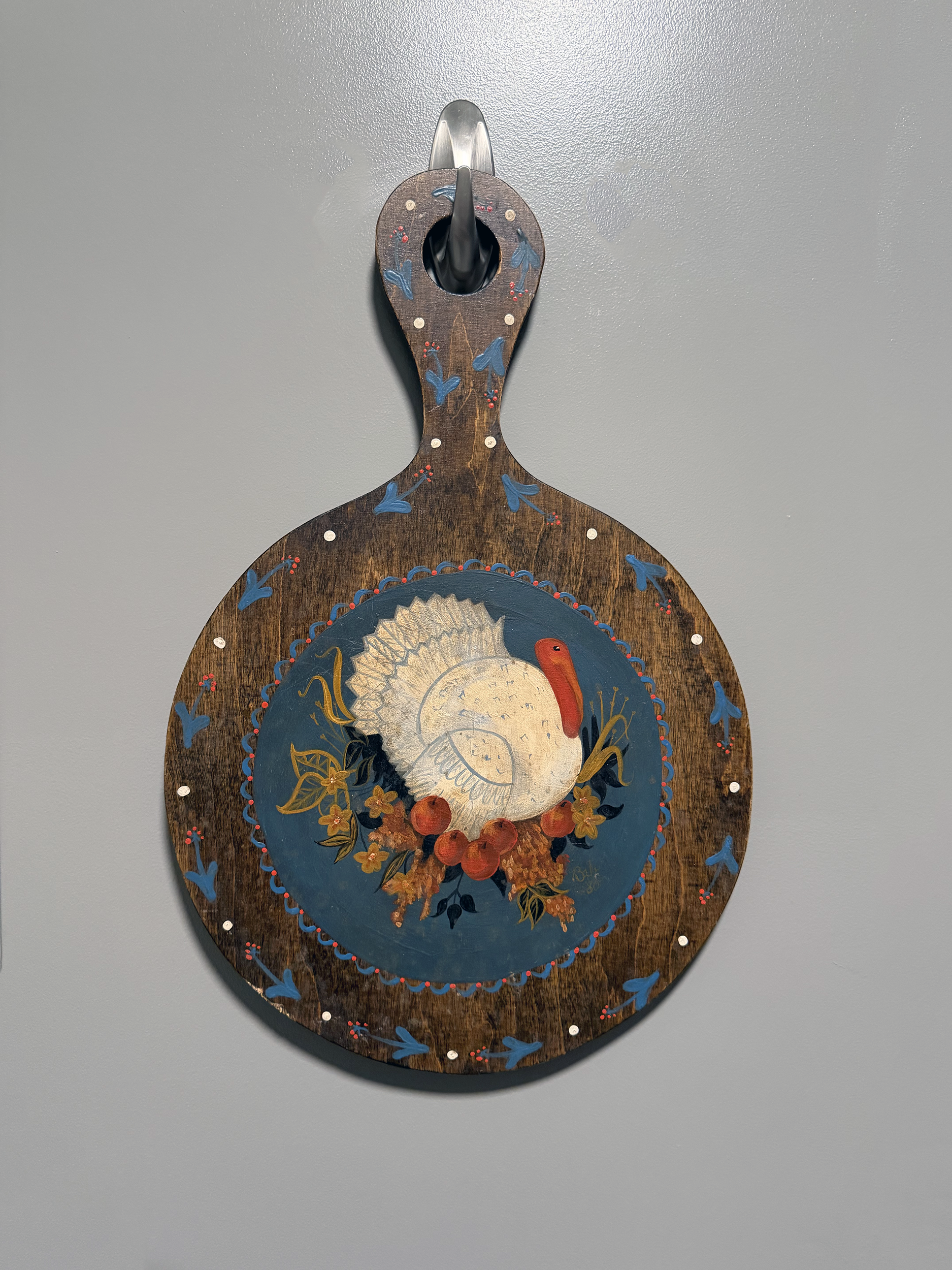
Then there was the Turkey Board. Ah, the Turkey Board! My mother had painted it herself: a magnificent plywood turkey, perhaps twelve inches across, surrounded by a bountiful riot of fruit and vegetables, the whole thing glowing with autumnal authority. It hung proudly on the side door every fall, announcing to the world that Thanksgiving was near and that somewhere inside, a woman with paintbrushes and seasonal purpose was not to be trifled with. As I grew older, the old methods of discipline gave way to more symbolic instruments, and the Turkey Board entered family history not merely as décor but as a kind of ceremonial paddle of justice. She never really hit me hard with it; that was not its genius. Its power was psychological. It had feathers. It had harvest produce. It had moral force.
One day, in the heat of some domestic skirmish whose original cause has vanished into the fog of childhood crime, I made a brilliant evasive maneuver. The Turkey Board missed me and struck the doorframe with a sickening whack. There was damage. A smear. A wound. My mother was aghast—not because I had escaped justice, but because I had marred one of the great autumn masterpieces of our time. She lamented the hours she had spent painting that turkey, and from then on, every glance at the side door reopened the injury. Eventually she repaired it, but the legend remained. Years later, when she downsized and the artifacts of our family civilization were being dispersed, I asked for the Turkey Board. Not out of sentiment exactly, and not out of guilt. I wanted it because some objects are more than objects. They are evidence. Proof that once upon a time, in a small house in a small place, my mother could turn plywood, paint, punishment, and Thanksgiving into one unforgettable family monument.