
Stock
Whenever I wasn’t occupied with the daily business of surviving my sister’s latest attempt to remove me from the family census, I roamed my aunt’s farm with the reckless freedom of a child who had not yet been formally introduced to consequences. In those days we inhabited a small Cape Cod sort of house—though to call it a house was to overlook its previous career as a coach house, which lent to the whole place the faintly suspicious air of having once known horses better than people.
My aunt owned a farm out in the countryside, the kind of place where a child with rubber legs, no judgment, and a powerful belief in her own immortality could thrive like a weed in July. The farm itself sprawled under the sun with a grand lack of self-consciousness—fields buzzing with grasshoppers, fence posts leaning like old men sharing private news, a dirt lane powdered pale as biscuit flour, and a barn so weathered it looked as though it had been chewed on for several generations by wind, rain, and large animals with time on their hands. Everything there smelled of hay, warm dust, manure, and some mysterious agricultural perfume that no city person could identify but every fly in the county considered irresistible. There was a little barn stocked with the usual rural cast: rams with hard heads and bad intentions, goats of mysterious purpose, and a horse or two who regarded us with the bored superiority of minor royalty.
But my great companion was Clyde, an ancient basset hound whose ears appeared to have been issued by the yard. I offered him treats with the solemn precision of a pharmacist filling a prescription for a very drooly patient, sometimes advancing my hand into that great velvet tunnel of a mouth as though I were mailing a package to the center of the earth. Clyde received the whole operation with damp, sagging dignity, and when I withdrew my arm lacquered in dog spit, neither of us considered the transaction anything but a success. Those were free days. I ran wherever I pleased, with Clyde or without him, while my sister suffered the indignity of being head-butted by the old ram against the wall. Animals could smell fear on her the way sharks smell blood. As for me, I feared only snakes and gators, and every night in my prayers I thanked God for all creatures great and small—with two firm exceptions.
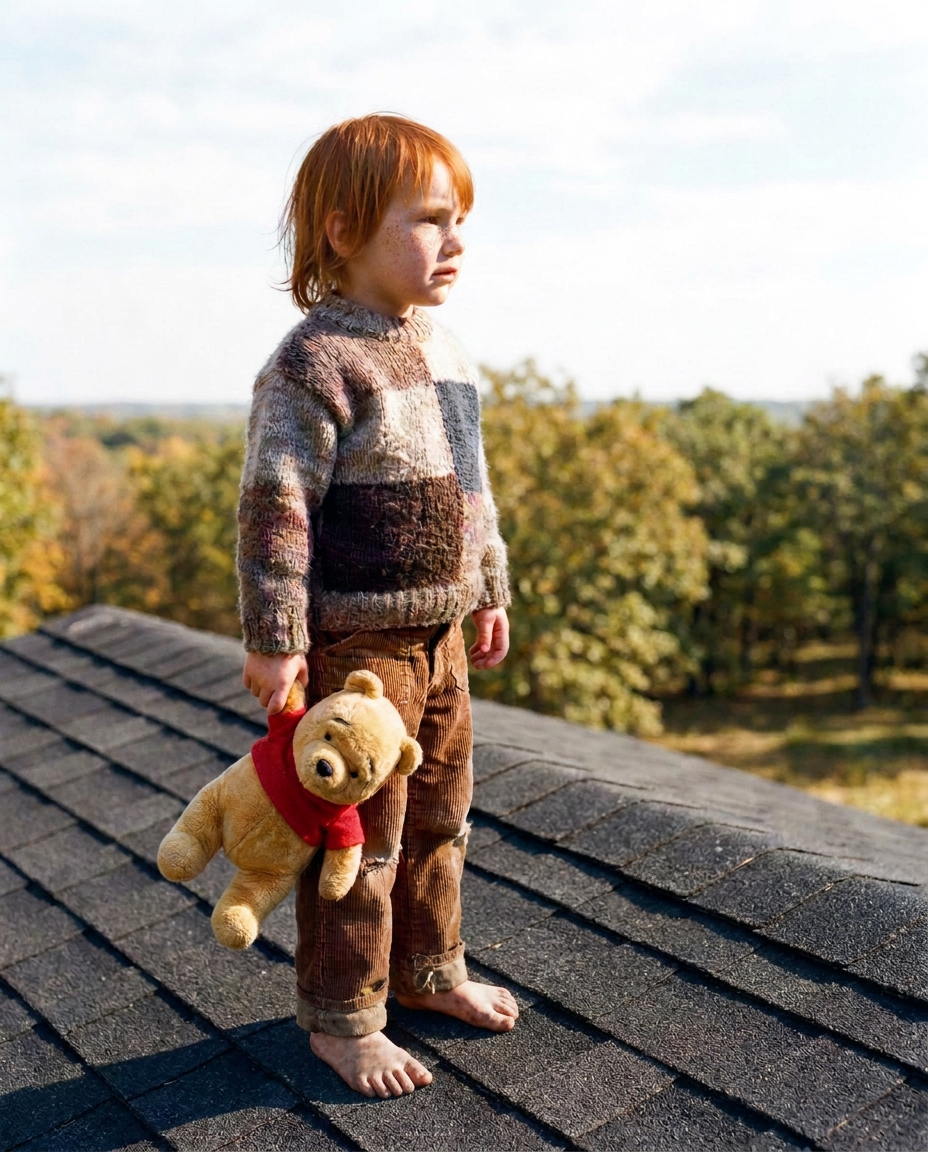
Then came the day of the roof. Every childhood contains, tucked somewhere in its official record, one brilliant idea so clear, so magnificent, so profoundly stupid, that it deserves a brass plaque. Mine was this: I would explore the roof. Out through the dormer I went, a small expeditionary force of one, and soon I had claimed the ridge in the name of all toddlers who had ever looked at gravity and found it overrated. Meanwhile, my mother discovered that I had vanished. Not misplaced, not hiding behind the sofa—vanished. She began searching with that special maternal panic that turns ordinary rooms into crime scenes. My sister arrived home from school and, observing the commotion, snapped in her natural command voice, “What is going on?” My mother, words tumbling over one another, cried, “Peanut is gone—help me look for her!” “Why?” said my sister, with just a trace too much interest. In her mind, I suspect, in her mind, trumpets were already sounding the return of the golden age: the blessed era before Peanut, when she alone ruled the domestic kingdom. She had been born bossy. Even as a preschooler she came home with one hand on her hip and the other stabbing the air, interrogating our mother about laundry, dishes, dusting, and whatever other failures of management had occurred during the day. She was a boss, yes—but the kind of boss who makes the workers pray for a transfer.
All of this unfolded while I, conqueror of shingles, surveyed my kingdom from above. My sister, drafted unwillingly into the search party, muttered darkly about homework and other pressing affairs of state. But like all great adventures, the roof eventually lost its sparkle. The thrill of conquest faded, the ridge became merely a ridge, and I slipped back through the same dormer by which I had escaped, unharmed, unbitten, and utterly unimpressed by the national emergency I had caused. My mother, overcome with relief, attempted to hug me. This was a mistake. To me, affection of that sort was not warmth; it was capture. A hug was not a hug—it was a bear trap with perfume. I twisted, shoved, wriggled, and fought my way free from her arms as though escaping a net on the high seas. Kisses, hugs, any gesture involving restraint: all were intolerable, physically unbearable, and deeply suspicious. My mother was relieved. I was liberated. And my sister, poor defeated monarch of the pre-Peanut era, stood by in irritation, forced once again to confront the grim truth: she had still not managed to get rid of me.